
Pain in the knee seems to disturb the everyday lives of patients. Even basic tasks might be hard and frustrating for the patients. Most people always try to ignore knee pain because they think that it might just vanish on its own. Nevertheless, untreated knee pain often only escalates, causing reduced movement capability and the inability to complete even the simplest actions. Moreover, a variety of treatment options are available for knee pain treatment, which can confuse the patient.
At Bones Cure, Dr. Waqas Javed suggests the best treatment option for your knee problems, including arthroscopic knee surgery after correctly diagnosing them. We use advanced technology for the diagnosis and efficient treatment of knee issues.
One of the most efficient surgical procedures that helps to cure a patient in an easy and non-invasive manner is Arthroscopic knee surgery. With the use of this technique, the orthopedic surgeon can easily make a diagnosis and treat the problem right after that. This article discusses the benefits of Arthroscopic knee surgery, its treatment procedure, and rehabilitation process.
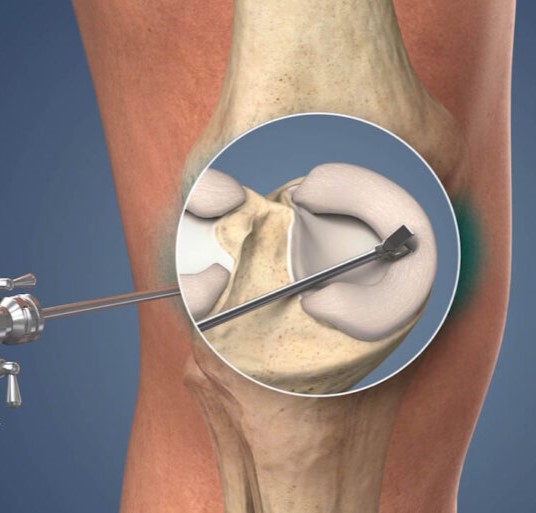
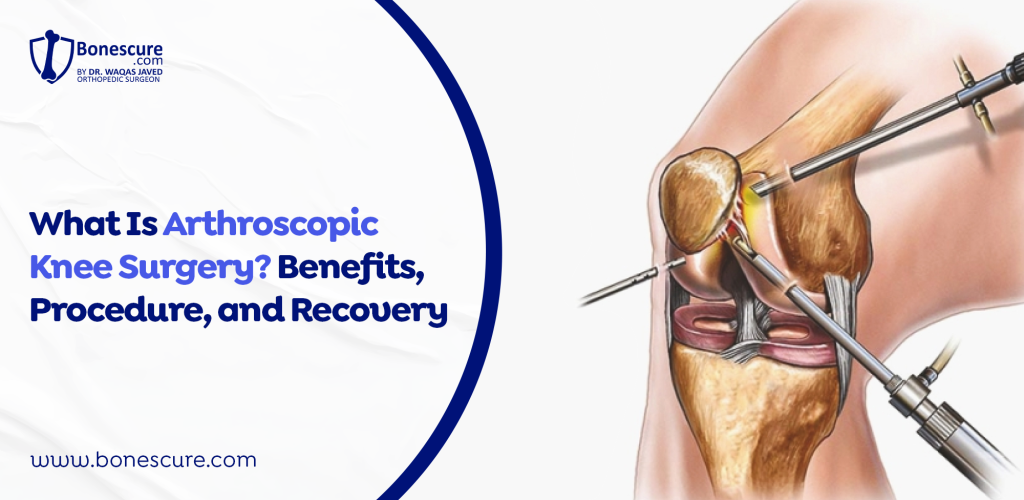
Arthroscopy comes from two Greek words—”arthro,” meaning joint, and “skopein,” meaning “look.” It literally means looking into the joint. In arthroscopic knee surgery, an orthopedic specialist will employ an extremely advanced, very thin device known as an arthroscope. The device is about the thickness of a pencil and contains both a fiber-optic camera and light. In this procedure, the surgeon simply makes two or three minute holes, sometimes called portals, around them rather than making big cuts.
The camera being used transmits real-time images that are high resolution and magnified onto an image screen located in the surgery room. With this clear vision, the surgeon can examine the inner workings of the knee for any signs of damage that might not be readily visible using an X-ray or MRI scan.
After pinpointing the area of injury, small surgical tools are then introduced through secondary openings to repair, shave, or remove any damaged tissues and turn a lengthy procedure into a quick, outpatient procedure.
The human knee joint is indeed one of the most intricate pieces of mechanical engineering. For the knee joint to move smoothly while carrying the body’s weight, the cartilage, ligaments, and tendons must function in perfect coordination. When significant joint damage occurs, knee replacement surgery can help restore mobility and improve quality of life. However, in case of an unexpected injury, an unforeseen twisting movement, or normal aging that causes an imbalance in the joint, one might suffer from excruciating pain and dysfunction.
When non-invasive treatments, such as physiotherapy or anti-inflammatory medicines, are not enough, then this arthroscopic approach is used. Some common benefits of arthroscopic knee surgery and problems that can be treated with arthroscopy include:
The meniscus is made up of two rubber-like wedge-shaped cartilages in the shape of the letter ‘C’. In case of a sudden twist, it may tear apart, creating sharp pain, swelling, and a locking feeling, due to which the knee catches while in motion.
There are major ligaments present within the body. Some of them are the anterior cruciate ligament and the posterior cruciate ligament. Arthroscopy helps in reconstructing these torn ligaments by using a graft.
After a traumatic event, bones and/or cartilage may become loose. They may also float inside the joint space. This will create unbearable pain and lock the joint, similar to how a stone would affect a door hinge.
The synovial membrane serves as protection for the joint. Any problem with chronic inflammation of this synovial membrane, the knee will become hot, painful, and stiff.
Relieve Knee Pain with Minimally Invasive Surgery and Expert Arthroscopic Solutions by Dr. Waqas Javed at Bones Cure
For many years, knee surgeries have been associated with large and deep cuts made in the front of the leg to access the problem area; thus, muscles and ligaments had to be cut through.
One of the major benefits of arthroscopic knee surgery makes it possible to avoid large openings, there is virtually no injury to any surrounding tissue. The described approach allows for great advantages in terms of the whole surgical process, which are mentioned in the table below:
| Feature | Traditional Open Knee Surgery | Arthroscopic Knee Surgery |
|---|---|---|
| Incision Size | 6 to 10 inches; significant tissue disruption | 2 to 3 tiny punctures (less than 1/4 inch each) |
| Hospital Stay | Requires multiple days of inpatient hospital care | Performed as a convenient outpatient procedure; return home the same day |
| Post-Operative Pain | Severe, requiring heavy, long-term prescription painkillers | Mild to moderate; easily managed with ice and basic medication |
| Recovery Timeline | Months of extensive healing before returning to work | Weeks; many return to light desk jobs within a few days |
| Infection Risk | Higher risk due to large open wounds | Exceptionally low risk due to minimal internal tissue exposure |
| Cosmetic Impact | Prominent, long, and permanently raised scar | Tiny, faint marks that fade to near-invisibility over time |
Explaining how the actual surgery day will be can make a huge difference and turn fear into confidence. Knowing what happens on the surgery day can help patients feel like participants in the recovery process.
As soon as the patient arrives at the surgical center, they will be taken to the pre-operative area. The friendly nursing staff will prepare the patient for surgery. Then, anesthesiology will consult the patient regarding optimal choices for complete comfort during surgery, which can be either general anesthesia (when the patient is asleep throughout), regional nerve block (anesthetizing the lower half of the body), or local sedation.
After the patient feels entirely relaxed and numb, the surgical staff applies antiseptic liquid to the joint and drapes the site to ensure total sterility. The orthopedic surgeon creates two to three tiny ports around the kneecap area. Sterile saline liquid is infused into the knee joint cavity using a thin plastic tube. The saline fluid expands the joint like a balloon, cleaning up cloudiness and providing a wide space for the doctor to see all the internal structures clearly.
The arthroscope is introduced into the joint through the first tiny port. The doctor moves the probe through the inflated space inside the joint while inspecting the structures under the camera, viewing high-definition pictures on the screen. After pinpointing the precise reason for the problem, the physician uses specific micro-instruments that will be inserted through additional incisions. Orthopedic surgery involves
When the process of knee repair surgery ends, the saline fluid used will be completely suctioned out. The physician will also withdraw the instruments. Then the incision site will be closed with a few sutures or adhesive dressings. Finally, the knee will be wrapped in sterile cotton gauze, and the patient will be moved to the post-operative ward to regain consciousness. If you are planning the procedure, understanding the ACL Surgery Cost can help you prepare for both the operation and the recovery process.
One of the major benefits of arthroscopic knee surgery is less recovery time compared to an open surgery. Here is what recovery looks like month by month:
Patients should:
In addition, Physical therapy can start after two weeks. It includes enhancing mobility, reducing inflammation, and improving muscle strength and flexibility.
Those who had surgery for ligament reconstruction or other procedures will be able to continue their recovery during this period. The patients might need further strength training to go back to playing sports again.
Suffering from knee pain is like dragging along a silent pain every day. The good news is that modern medicine has come up with various ways that are more efficient than ever before. One such way is arthroscopic knee surgery, which helps to detect and treat many diseases associated with the knee joint. At Bones Cure, patients can get the benefits of arthroscopic knee surgery through modern and advanced arthroscopic services to diagnose and treat knee issues.
Whether you need treatment for torn cartilage, damaged ligaments, or loose bone fragments within the knee joint, consulting an experienced orthopedic surgeon like Dr. Waqas Javed can help restore knee function and get you back to your daily activities as quickly and safely as possible.
If you are always complaining about knee pain or feel that you cannot perform all the movements comfortably, consulting with Dr. Waqas Javed could mean getting back to health and happiness. Following the prescribed procedure and doing everything to achieve your health goals, you will soon be restored.