
If the surgeon recommends knee replacement surgery for the treatment of knee problems, the patient might get anxious. Patients planning Knee Replacement Surgery in Lahore often face confusion when choosing between cemented and non-cemented implants. Both options have their benefits, and all patients want is a successful surgery that gets them back on their feet, pain-free and mobile. They find it difficult to choose between them. All they want is to get back on their knees after getting a successful surgery.
However, if the patients have knowledge and understanding of both types of knee replacement surgery, they can easily choose the best type. Moreover, the orthopedic surgeon can also suggest the best choice for knee replacement to a patient based on their condition. Dr. Waqas Javed is an orthopedic surgeon who expertly performs both cemented and uncemented knee replacement surgeries to restore the knee function of patients.
This article explains both types of knee replacement procedures in detail to help patients know about them.
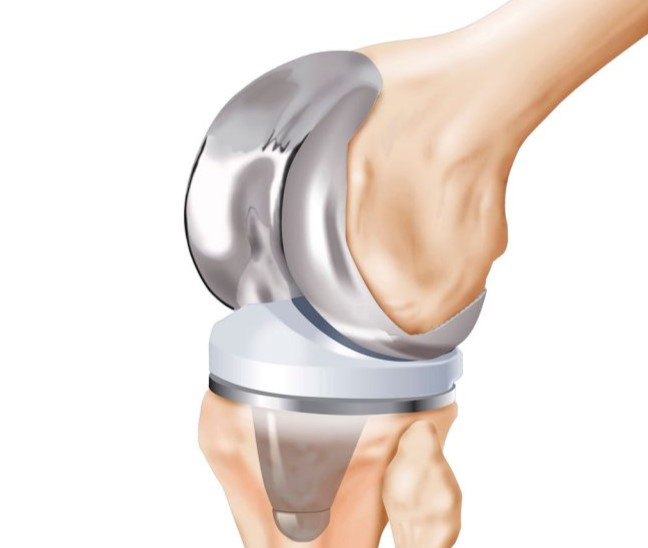
Knee replacement surgery is a procedure performed by a surgeon in which damaged parts of the knee are replaced by artificial components. The result of the surgery is a reduction in symptoms caused by the damaged knee joint. The artificial components used are made up of metal, plastic, or ceramic materials. The surgery is usually recommended for patients suffering from:
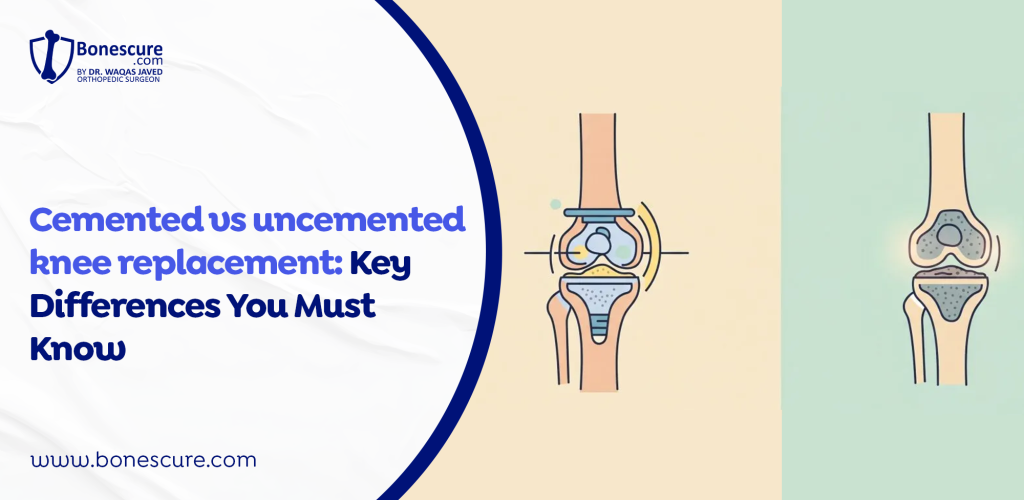
One of the most important decisions during surgery is how the artificial implant will attach to the bone. Based on this, the knee replacement surgery can be cemented or uncemented. The goal is to anchor these components firmly to the bone so that they can last longer and provide flexibility to the patient.
The Cemented Approach relies on the use of a quick-drying special bone cement. The material used in such operations is normally polymethylmethacrylate (PMMA), which is a medical-grade acrylic polymer. Such a product is used as an interlocking glue between the prosthesis and the bone surface.
The Uncemented Approach is sometimes called “press fit.” The latter does not involve any chemical adhesives at all. Prosthetic parts have a special micro-texture, rough, or porous coating. These coatings may include various advanced products, such as tantalum, 3D-printed titanium, or hydroxyapatite coatings. In other words, the surfaces have to encourage natural bone to grow right into it.
The fundamental distinction is that one approach requires a chemical bond, whereas the other involves biological processes. Each method has its own biological features and advantages. Whether discussing Total vs Partial Knee Replacement Surgery, both procedures ultimately aim to achieve the same result: pain relief and improved mobility.
| Feature | Cemented Knee Replacement | Uncemented Knee Replacement |
|---|---|---|
| Fixation Method | Bone cement | Natural bone growth |
| Initial Stability | Immediate | Gradual |
| Recovery Speed | Usually faster early recovery | Bone healing takes time |
| Best For | Older adults with weaker bones | Younger, active patients with strong bones |
| Long-Term Bond | Mechanical fixation | Biological fixation |
| Surgical Popularity | Most commonly used | Less common but growing |
| Risk of Loosening | Slight risk over many years | Lower risk if the bone grows properly |
| Bone Quality Needed | Moderate | Excellent bone quality |
Cemented technology has been regarded as the standard orthopedic clinical method for many years. For the vast majority of patients across the globe, such traditional treatments are reliable and used frequently. In the case of cemented operation, the mixture of the two constituents of the PMMA acrylic polymer, namely the powder and liquid, is mixed by the surgeon.
After that, the paste is glued to the prepared bony surfaces while the implants are placed in a tight manner. Such a chemical element passes through an exothermic reaction, dries up, and solidifies in about 10 minutes.
Since the chemical composition cures completely prior to the patient leaving the operating room, structural stability is attained immediately after the procedure. There will be no worries about whether or not the replacement knee will offer structural strength initially.
Since there is already full stability of the implant upon surgical completion, patients can immediately walk while using support devices such as walkers or crutches when necessary. Doing so will help reduce muscle atrophy from occurring and will lessen post-operative issues.
The surgeon can add specific amounts of antibacterial drugs to the liquid bone cement formula, which delivers localized protection to the surgical area, thus minimizing the occurrence of infections early on in recovery.
The cement being used will enter the micro-spaces within the bones, and will not depend on the natural healing properties of the bone. Hence, it is well-suited for use by elderly people, including those who suffer from osteopenia or osteoporosis.
However, despite its outstanding history, there are still material limitations associated with the use of bone cement. Within 15–20 years of the patient’s activity, due to the repeated load exerted on the thin cement layer, fatigue cracking may occur. Fatigue cracking leads to a pathological condition called aseptic loosening.
Due to this, the device becomes detached from the bone tissue without the presence of any infections. Moreover, very rarely, small particles of bone cement may become loose and start irritating the surrounding tissue, which may lead to inflammation.
In the case of the uncemented knee replacement surgery, the principle lies behind the biological bonding of the artificial knee joint. This particular method considers the artificial joint implantation as part of the natural bones of the body. Under the uncemented knee joint replacement surgery, high-precision surgical tools are used. With the help of robots, the bone is trimmed to match the inside surface structure of the press-fit implant. The implant is then pushed firmly into place with the natural bone.
The initial strength of the implant depends upon its friction fit in the bone. However, in the coming weeks and months, a biological process of osseointegration takes place, in which living bone cells grow into the implant, bridging a gap of 1 to 2 millimeters.
The implant merges with living bone, and the bond becomes subject to continual biological remodeling and may increase in strength as a result of physical load-bearing. Unlike artificial cement that decays over time, this biological joint can strengthen in response to mechanical activity.
When a relatively young and active person has a joint replacement surgery, it might be necessary to perform the revision surgery after decades of wear and tear of the artificial joint. With uncemented implants, no scraping of old and hardened bone cement is required; the body retains its own bone stock.
It takes a lot of time to prepare the cement mixture, apply it, and wait until it dries. The elimination of these steps results in reduced operating and tourniquet times, thus decreasing the number of possible early complications from surgery.
Since bone cement is not used, one completely eliminates the risk of local thermal injuries from the process of polymerization, chemical hypersensitivity to the components of cement, as well as the unlikely but potential cardiovascular problems arising from embolism.
The main drawback of the technique is the dependency on the patient’s natural bone quality. Those suffering from low bone mineral density, advanced osteoporosis, or some bone metabolism disorders cannot be considered suitable candidates.
This is because it would not be possible for the bone to grow sufficiently to hold an implant tightly. Also, owing to the biological nature of bone ingrowth, which may take as long as 12 weeks, some individuals can have mild post-operative pain for a certain period of time, even though it is temporary. In some cases, a special kind of weight-bearing is recommended for the first month.
Being affected by severe knee pain on a continual basis certainly makes living more difficult. However, there is an effective way to regain your old life back again, through the process of knee replacement surgery. Although the differences between the methods of cemented vs uncemented fixation systems might be quite complicated at first sight. They simply represent two different ways to achieve the same ultimate goal: a stable, pain-free joint that restores long-term mobility.
Be it the advantage of having an instant and reliable bond created with the traditional bone cement, or getting a permanent bond using the new press-fit implants, the success rate in either case is quite impressive in today’s world. Patients are advised to make use of such knowledge while communicating freely with their orthopedists.
Dr. Waqas Javed can perform both cemented and uncemented knee replacement surgery in Lahore with a success rate of more than 95%. At Bones Cure, a trusted orthopedic medical center, patients receive advanced treatment and personalized care for their knee problems. By working in collaboration with a good surgical team, it becomes quite easy for patients to pick the best way forward that suits them personally.