
Patients who suffer from chronic knee pain try various treatment methods. They might have used injections, tried physical therapy, applied gels, or used medications. But the pain stays the same, stealing the joy from their life. The real reason behind their pain is damage to the knee joint. This pain can only be managed through knee replacement surgery if all other treatment methods have failed.
When patients come to know about the two types of Knee Replacement Surgery in Lahore, they often get confused about which one to choose. Both types of knee replacement surgeries aim to relieve pain and restore mobility for the patient. But their purpose is different. Understanding the basics about both types can help the patient to make the right decision for their health.
At Bones Cure, Dr. Waqas Javed, a premier orthopedic surgeon in Lahore with over 20 years of dedicated experience, provides highly successful knee replacement surgeries. Whether your condition requires a partial or total knee replacement, he offers expert, precision-driven care designed to eliminate pain and restore your mobility.
This article explains the difference between total and partial knee replacement surgery. It also discusses the benefits and results achieved from both surgeries.
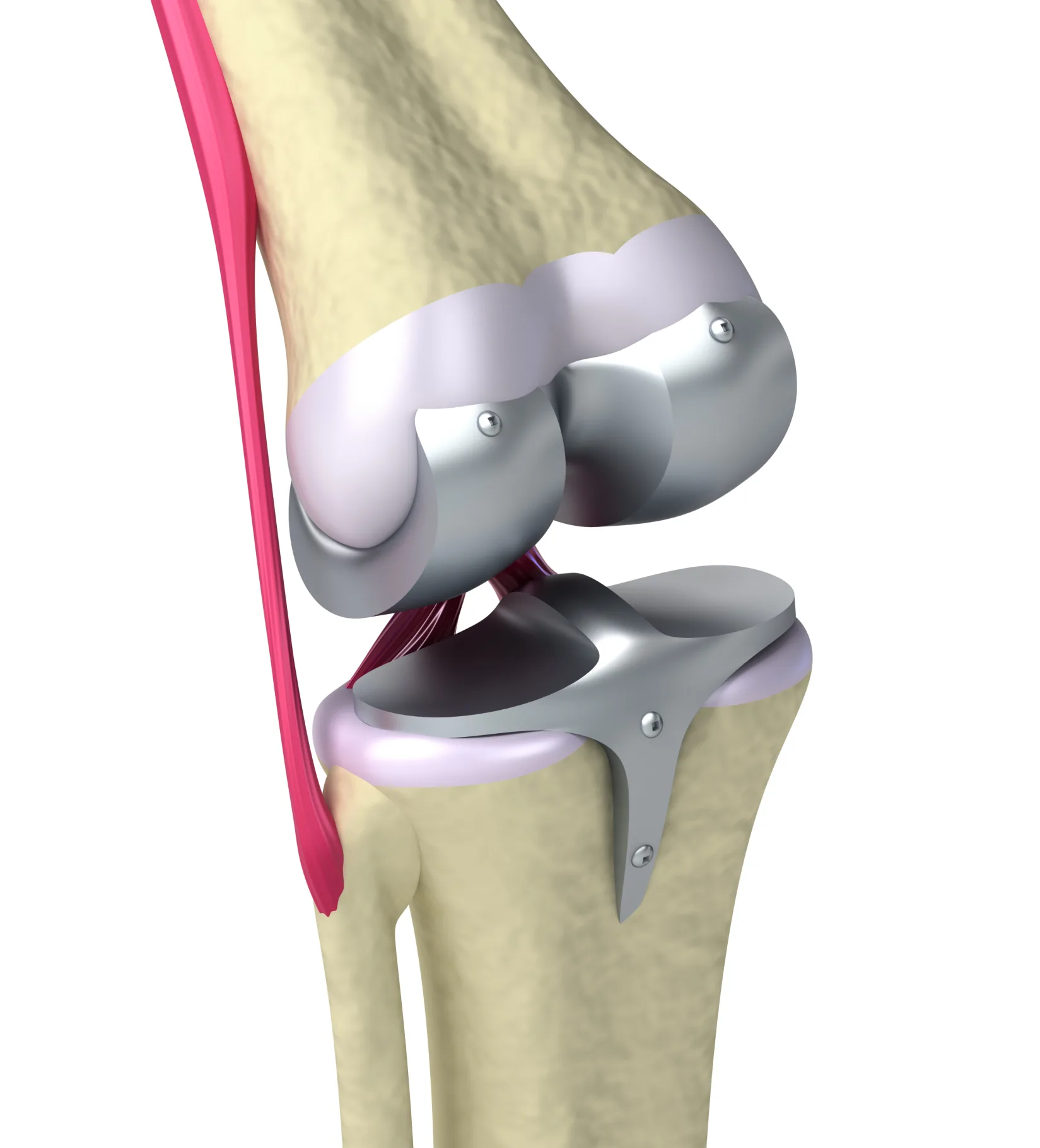
Before understanding knee replacement surgery, it is crucial to know about the anatomy of the knee. The joint of the knee is made up of three main compartments:
In a healthy knee, all these compartments work together in harmony and make smooth movements possible. Due to an injury or arthritis, damage occurs in these compartments, and the knee bones begin to rub against each other. The result is swelling, stiffness, and severe pain in the knee. Sometimes only one part of the knee is affected, while in some cases the entire knee joint can also be damaged.
In order to treat these compartments of the knee joint, knee replacement surgery is performed. It is a medical procedure in which the damaged parts of the knee are replaced with metal or high-grade plastic. These are artificial smooth surfaces that resemble the human knee. There are two types of knee replacement surgeries i-e; total knee replacement and partial knee replacement.
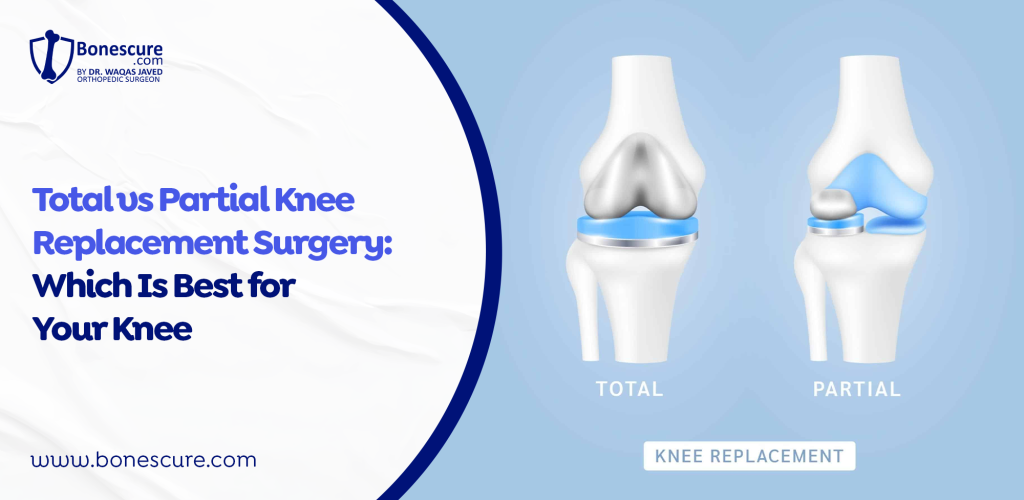
A Total Knee Replacement (TKR) is the most common type of Knee Replacement Surgery. All three compartments of the knee joint are replaced with artificial components in TKR. It provides complete “resurfacing” of the knee joint. It is best for patients suffering from severe arthritis with extreme knee joint damage. Patients who have a knee deformity and are suffering from extreme knee pain are also advised by the orthopedic surgeon to undergo TKR. Total knee replacement provides long-term pain relief to the patient. It also improves the stability and movement of the knee joint.
Partial knee replacement (PKR) is also called unicompartmental knee replacement. During this procedure, a part of the knee joint is replaced with an artificial joint. In this way, the healthy parts of the knee are preserved. Only those portions are replaced that are damaged. It is a less invasive procedure and provides faster recovery as compared to TKR. An orthopaedic surgeon recommends PKR when the knee for damage is limited to a single compartment. If the knee ligaments are strong and stable, then PKR can be an option to replace the damaged portion.
Understanding the differences between the two procedures can make decision-making easier. Both procedures are effective forms of Knee Replacement Surgery, but the choice depends mainly on the extent of joint damage.
| Feature | Total Knee Replacement | Partial Knee Replacement |
|---|---|---|
| Area Replaced | All 3 compartments (entire knee joint) | Only damaged compartment (usually inside) |
| Incision Size | 8–12 inches (larger incision) | 3–5 inches (smaller incision) |
| Hospital Stay | 1–3 days | Often same-day (outpatient) |
| Recovery Time | 3–6 months for full activity. Recovery takes longer. The initial pain and swelling are more significant. | 3–6 weeks for most tasks. Recovery is shorter and faster. Initial pain is less. |
| Ligament Status | Removes damaged cartilage and replaces all surfaces. Ligaments (ACL/PCL) are often removed or balanced. | Preserves healthy cartilage, both cruciate ligaments (ACL/PCL), and bone. |
| Best for | Severe arthritis affecting the whole knee (all 3 compartments) | Arthritis is limited to one area. Damage is in one compartment. |
| "Natural" Feeling | The knee may feel different, as the mechanics are entirely implant-driven. | Many patients report the knee feels more "natural" due to preserved anatomy. |
| Longevity | 20–25 years | 10–15 years (may need future TKR) |
There are certain factors that can be considered while choosing a knee replacement surgery. The best advice is provided by an experienced orthopedic surgeon. Because only a specialist knows which therapy will work best for the patient. Usually, an orthopaedic surgeon evaluates the extent of Knee damage through imaging such as X-rays and MRIs, and certain tests. The age of the patient and their activity level are also checked. Moreover, patient weight and overall health also matter before recommending a particular type of knee replacement.
Patients’ knee stability and alignment are also considered. Another important factor is the expectations of patients from the surgery and their lifestyle goals. So, there is no single answer that works for everyone. For example, if the entire joint of a patient is severely affected, then total knee replacement will be beneficial. However, if the damage is limited to one compartment of the knee, then partial knee replacement would be the best option.
Both types of knee replacement surgeries aim to relieve the pain. These surgeries have helped millions of people regain mobility and independence. The joint stability is improved, and the knee aligns much better after surgery. Patients are able to perform daily activities with comfort. Walking and climbing stairs feel normal again.
Specifically, TKR provides long-lasting results (often 15–20 years). The initial days after a TKR surgery are complicated. Patients feel pain and swelling, and they must follow the physical therapy routine strictly. But the long-term benefits are much more.
In contrast, a PKR is a less invasive surgery with smaller surgical scars. Less blood is lost during surgery. The recovery is faster and easier with less pain and swelling. The knee movement feels more natural because only one compartment is replaced with an artificial joint. As most of the knee is natural, there is a risk of developing arthritis in those parts of the knee. This may require a second surgery down the road.
Chronic knee pain is frustrating and overwhelming. It can turn simple daily tasks into painful struggles. Both the physical and emotional health of patients are affected because of constant knee pain. With the advancement in technology, knee replacement surgery is a reliable solution for people with severe knee damage. It has been successful in providing the desired benefits to patients.
Both types of knee replacement surgeries have their own advantages. If the damage is advanced, a total knee replacement surgery is ideal for the patient. But if the damage is limited to one area. then partial need replacement could be the best choice. The right choice depends on the patient’s condition, lifestyle, and long-term goals.
Bones Cure, a specialized orthopedic treatment center, offers successful treatment for chronic knee pain through advanced knee replacement surgery. Dr. Waqas Javed, a leading orthopedic surgeon, specialises in both total and partial knee replacement surgery. With extensive experience of more than 20 years, our orthopaedic surgeon treats the knee joint to provide lasting benefits to patients. Consult Dr. Waqas Javed and make the right choice for your knee joints. A life without that constant ache is waiting on the other side of this decision. Take the first step toward it today.